A grid-scale battery is a large battery connected to the transmission grid that stores electricity and releases it. It earns money by selling the "capacity" to fix surpluses and shortages of electricity, and by using price differences between times of day. These notes use published figures and our own records to show this month's trends in figures and tables. This issue is a back issue, prepared retroactively in November 2026. The grid connection study figures are as of the time of preparation (October 19, 2026).
Science X Inc. · Published November 5, 2026 · A4, 15 pages
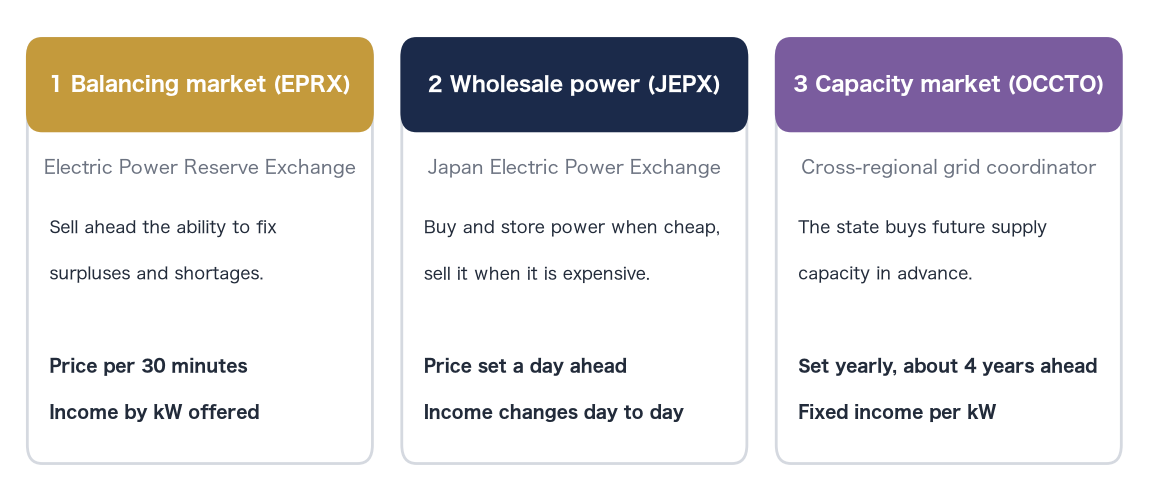
A battery storage plant (grid-scale battery) earns revenue from three markets. ① In the balancing market (EPRX), it sells grid operators the "capacity" to fix surpluses and shortages of electricity. ② In wholesale electricity (JEPX), it buys and stores electricity at cheap times and sells it at expensive times. ③ In the capacity market (OCCTO), the country buys future electricity supply capacity in advance. These notes list the figures for these three markets in that order. The ①, ② or ③ at the start of each section title shows which market it covers.

Source: Rules of the Japan Electric Power Exchange (JEPX), the Electric Power Reserve Exchange (EPRX) and the Organization for Cross-regional Coordination of Transmission Operators (OCCTO).
We picked three of this month's trends from the figures of the three markets.
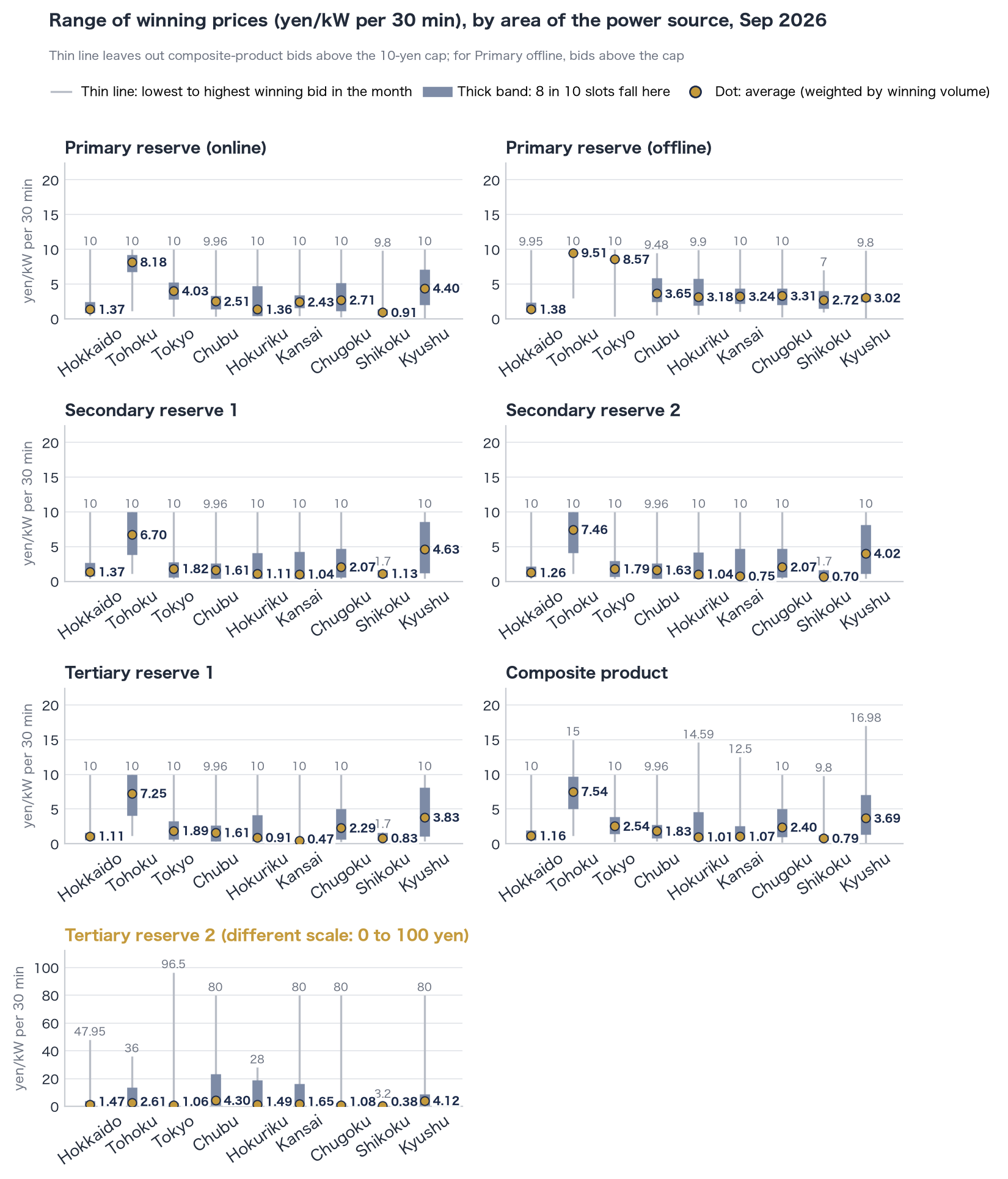
The balancing market is where grid operators buy, every 30 minutes, the "capacity" to fix surpluses and shortages of electricity. Products are split by how fast they change output (Primary reserve responds to changes in frequency; Secondary and Tertiary reserves respond to instructions from grid operators). Primary reserve is the fastest, and Tertiary reserve 2 is the slowest. Primary reserve senses frequency changes on its own and responds. It has two categories. In "online", the grid operator monitors operation over a dedicated line. In "offline", no dedicated line is installed, and a record of the operation is submitted afterwards. The two are procured and traded separately, so we show them separately. A Composite product is a bid that combines several products. Prices are set in yen per 1 kW of available capacity per 30 minutes. kW is the unit for how much power can be delivered. It is different from kWh, which measures an amount of electricity. Each 30-minute trading round is called a "30-minute slot". The figure shows the range of winning prices by area (by the area where the power source is located). The thin line runs from the cheapest to the most expensive bid in the month. The thick band is the price range covering 8 out of every 10 slots with awards. The dot is the average winning price. Nationwide figures are in the tables in the "Market figures" section.
Among balancing market average winning prices by area, Primary reserve (offline) in Tohoku was the highest at 9.51 yen/kW per 30 min, and Tertiary reserve 2 in Shikoku was the lowest at 0.38 yen/kW per 30 min.

Source: Trading results (preliminary) published by the Electric Power Reserve Exchange (EPRX). Compiled by ScienceX.
| Product | Response time | Duration |
|---|---|---|
| Primary reserve (online) | Within 10 seconds | 5 minutes or more |
| Primary reserve (offline) | Within 30 seconds | No set duration |
| Secondary reserve 1 | Within 5 minutes | 30 minutes |
| Secondary reserve 2 | Within 5 minutes | 30 minutes |
| Tertiary reserve 1 | Within 15 minutes | 30 minutes |
| Tertiary reserve 2 | Within 60 minutes | 30 minutes |
| Composite product | Requirements of the combined products | Requirements of the combined products |
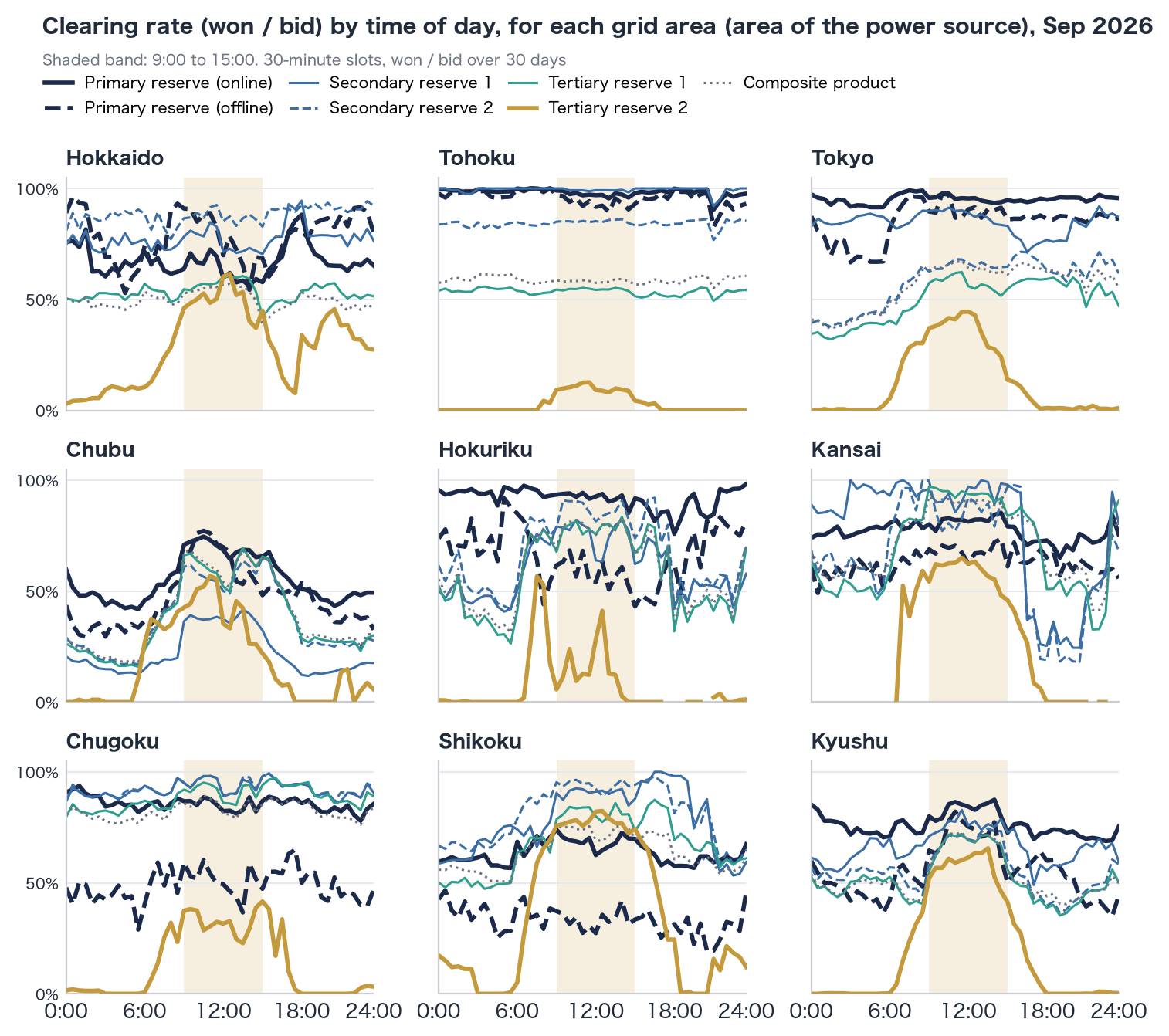
The award rate is the share of the bid volume that was awarded. The higher it is, the more easily a bid wins. The figure plots, for each grid area (the area where the power source is located), the award rate of each product by time of day (every 30 minutes). Where a line breaks, there were no bids at that time.

Source: Trading results (preliminary) published by the Electric Power Reserve Exchange (EPRX). Compiled by ScienceX.
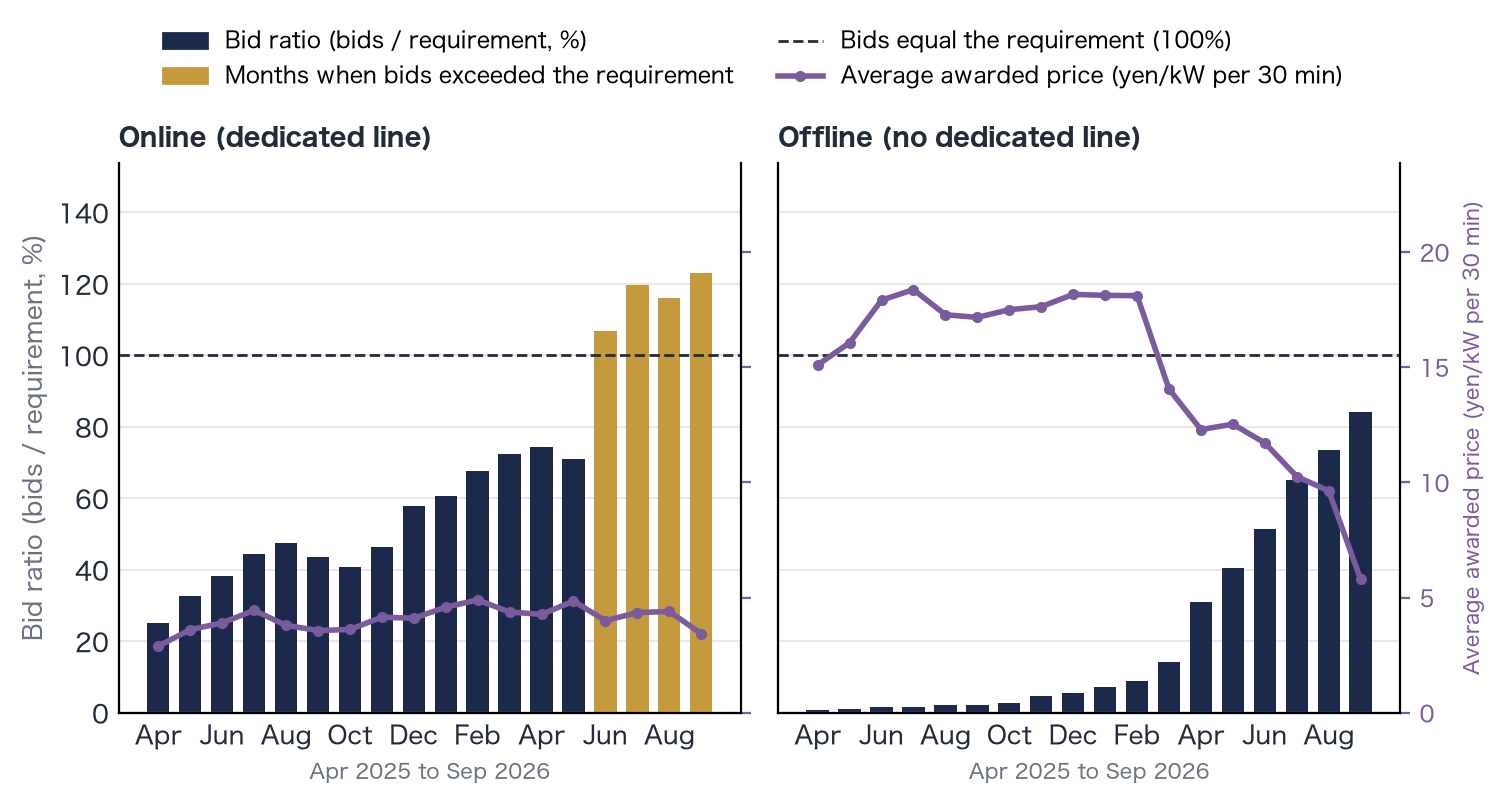
Primary reserve is the fastest product. It responds to frequency changes and changes output within 10 seconds (online) or within 30 seconds (offline). Batteries are often used for it. The left panel is the online category, and the right panel is the offline category. The bars are the bid-to-requirement ratio (bid volume ÷ volume requested by grid operators). Above 100% means more bids came in than were requested. Even below 100%, some bids are not awarded (see the award rate in the "Market figures" tables). The bars rise when bids increase, and also when the requested volume falls. The line is the average winning price. The figures are monthly, from April 2025, the earliest we have.
In the balancing market, the bid-to-requirement ratio for Primary reserve (online) passed 100% in June 2026 at 106.8%, and this month it was 123.1%. The average winning price was 3.43 yen/kW per 30 min. The requested volume was 3,066.1 MW in April 2025 and 1,388.7 MW this month. For Primary reserve (offline), this month's bid-to-requirement ratio was 84.0% and the average winning price was 5.79 yen/kW per 30 min. The requested volume was 1,122.5 MW in April 2025 and 497.8 MW this month.

Source: Trading results (preliminary) published by the Electric Power Reserve Exchange (EPRX). Compiled by ScienceX.
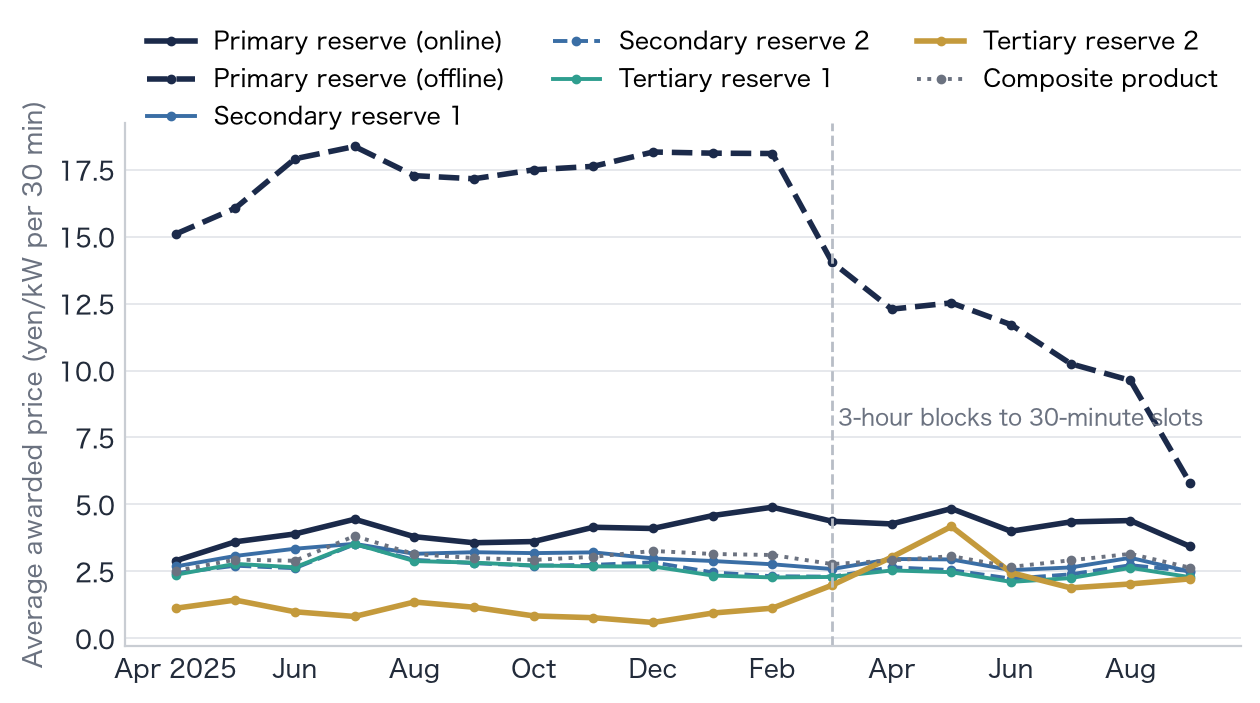
These are average winning prices by product from April 2025 (monthly averages weighted by awarded volume). From March 14, 2026, Primary reserve through Tertiary reserve 1 and the Composite product moved from trading every 3 hours to trading every 30 minutes (Tertiary reserve 2 was already traded every 30 minutes).
In the balancing market, average winning prices from April 2025 to this month went from 2.89 yen to 3.43 yen for Primary reserve (online) (peak 4.90 yen in February 2026), and from 1.12 yen to 2.22 yen for Tertiary reserve 2 (peak 4.18 yen in May 2026).

Source: Trading results (preliminary) published by the Electric Power Reserve Exchange (EPRX). Compiled by ScienceX.
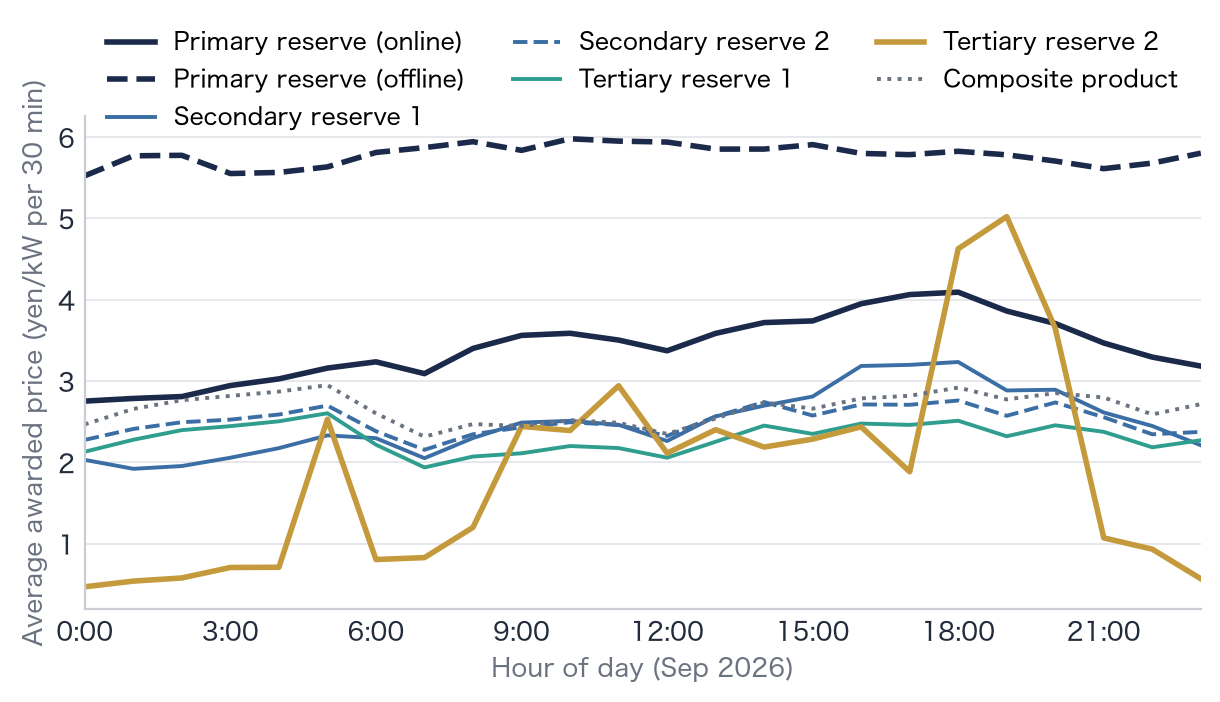
These are hourly average winning prices by product for September 2026 (days 1–29).
The hours with the highest and lowest average winning prices in the balancing market were the 19:00 hour (5.02 yen) and the 0:00 hour (0.47 yen) for Tertiary reserve 2, and the 18:00 hour (4.09 yen) and the 0:00 hour (2.75 yen) for Primary reserve (online).

Source: Trading results (preliminary) published by the Electric Power Reserve Exchange (EPRX). Compiled by ScienceX.
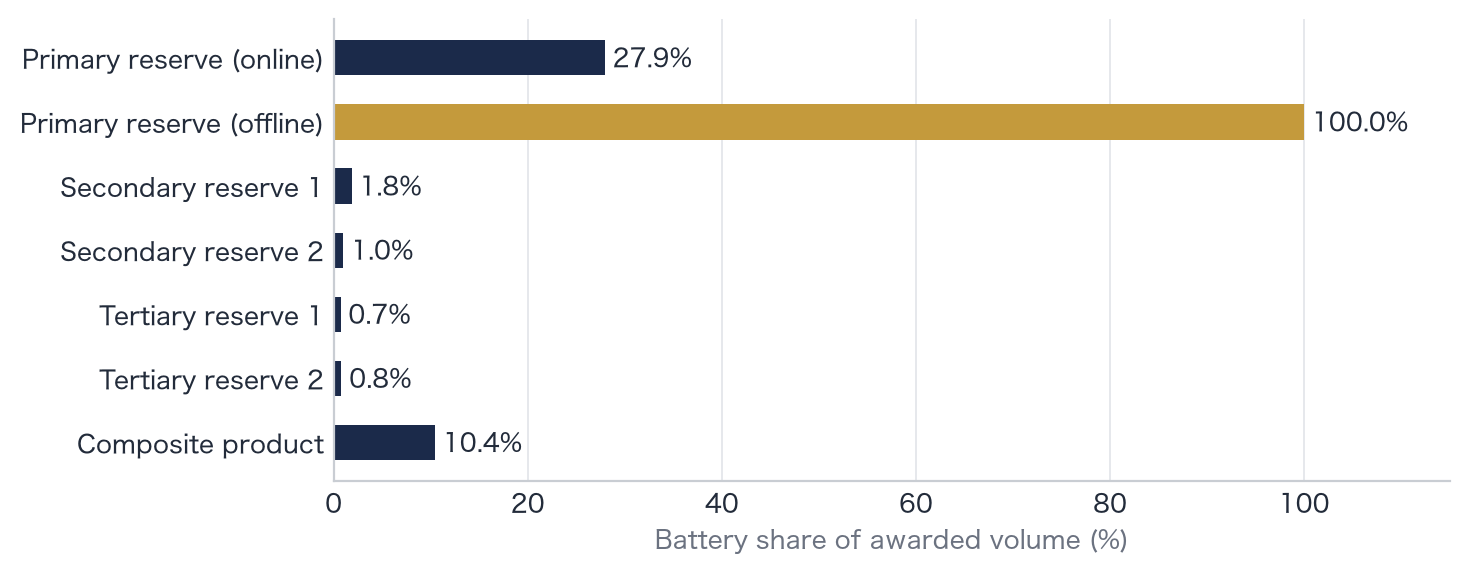
The figure shows batteries' share of the awarded volume. The table compares the average winning price of batteries' awards with the average winning price of the product as a whole.
In Primary reserve (online) in the balancing market, batteries had a 27.9% share. The average winning price of batteries' awards was 5.17 yen/kW per 30 min, against 3.43 yen/kW per 30 min overall.

Source: Trading results (preliminary) by power source type published by the Electric Power Reserve Exchange (EPRX). Compiled by ScienceX.
| Product | Batteries' awards (yen/kW per 30 min) | Whole product (yen/kW per 30 min) |
|---|---|---|
| Primary reserve (online) | 5.17 | 3.43 |
| Primary reserve (offline) | 5.79 | 5.79 |
| Secondary reserve 1 | 2.18 | 2.49 |
| Secondary reserve 2 | 1.85 | 2.51 |
| Tertiary reserve 1 | 1.86 | 2.28 |
| Tertiary reserve 2 | 59.26 | 2.22 |
| Composite product | 5.13 | 2.64 |
Both are averages weighted by awarded volume (September 2026, preliminary, nationwide). Batteries account for only 0.8% of the awarded volume of Tertiary reserve 2. The nationwide average winning price of the 30-minute slots where batteries won, weighted by batteries' awarded volume, is 5.82 yen. The batteries' average is high not because their awards are concentrated in high-price slots, but because the batteries' bids themselves are priced high (each winning bid is paid its own bid price).
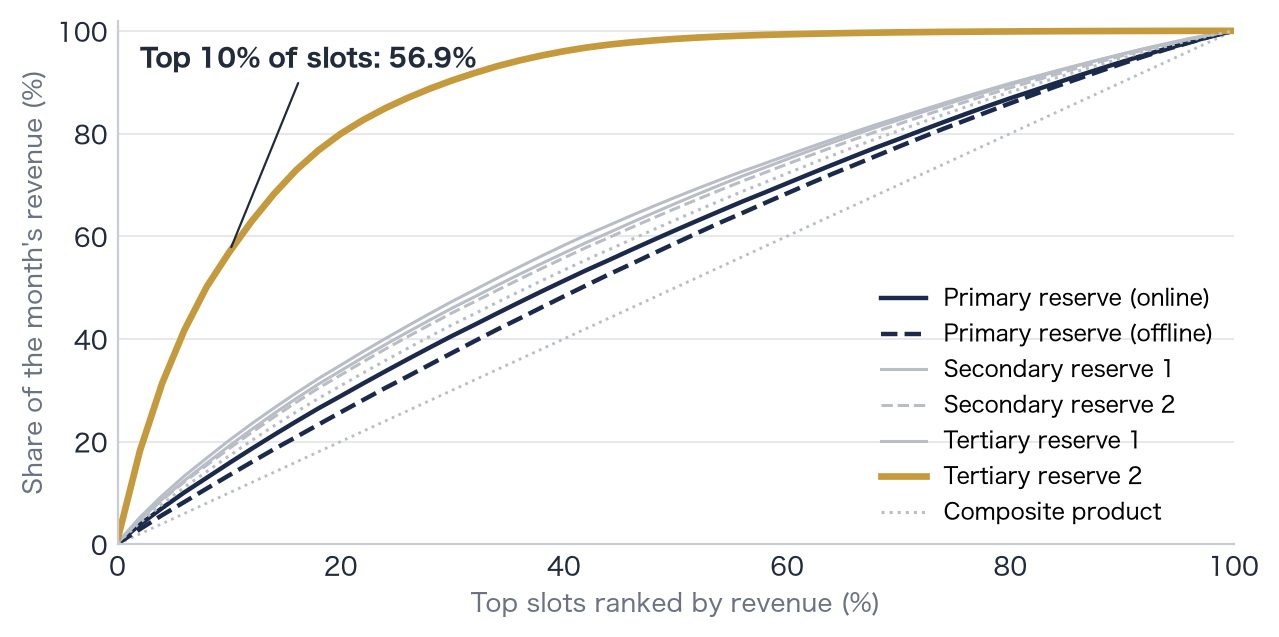
We ranked the month's 30-minute slots with awards by revenue (average winning price × awarded volume, nationwide). For each product, we plotted what % of the month's revenue the top slots make up. The more the curve bulges above the dotted line, the more revenue is concentrated in fewer slots. Tertiary reserve 2 is the product that covers errors in forecasting weather-dependent renewable generation. Its price is low in most slots and high in a very small number of slots.
In the balancing market, the top 10% of slots by revenue made up 56.9% of the month's revenue for Tertiary reserve 2 and 15.8% for Primary reserve (online). For the top 5%, the shares were 36.9% and 8.6%.

Source: Trading results (preliminary) published by the Electric Power Reserve Exchange (EPRX). Compiled by ScienceX.
In September 2026, of the 1,194 slots with awards, the top 1% by revenue (average winning price × awarded volume) made up 10.1% of the month's revenue. There were 25 slots with a nationwide average winning price of 10 yen/kW per 30 min or more, and 198 slots with no awards.
Slots with the highest top winning prices (by area where the power source is located). The highest winning price is the price of the single most expensive awarded bid. The average winning price for the same slot and area is shown to the right:
| Date | Time | Area | Highest winning price (yen/kW per 30 min) | Average winning price, same slot and area (yen/kW per 30 min) |
|---|---|---|---|---|
| September 8 | 9:30 | Tokyo | 96.50 | 6.01 |
| September 8 | 10:30 | Tokyo | 96.50 | 6.28 |
| September 8 | 11:00 | Tokyo | 96.50 | 6.56 |
| September 27 | 11:00 | Tokyo | 96.00 | 5.82 |
| September 27 | 11:30 | Tokyo | 96.00 | 5.18 |
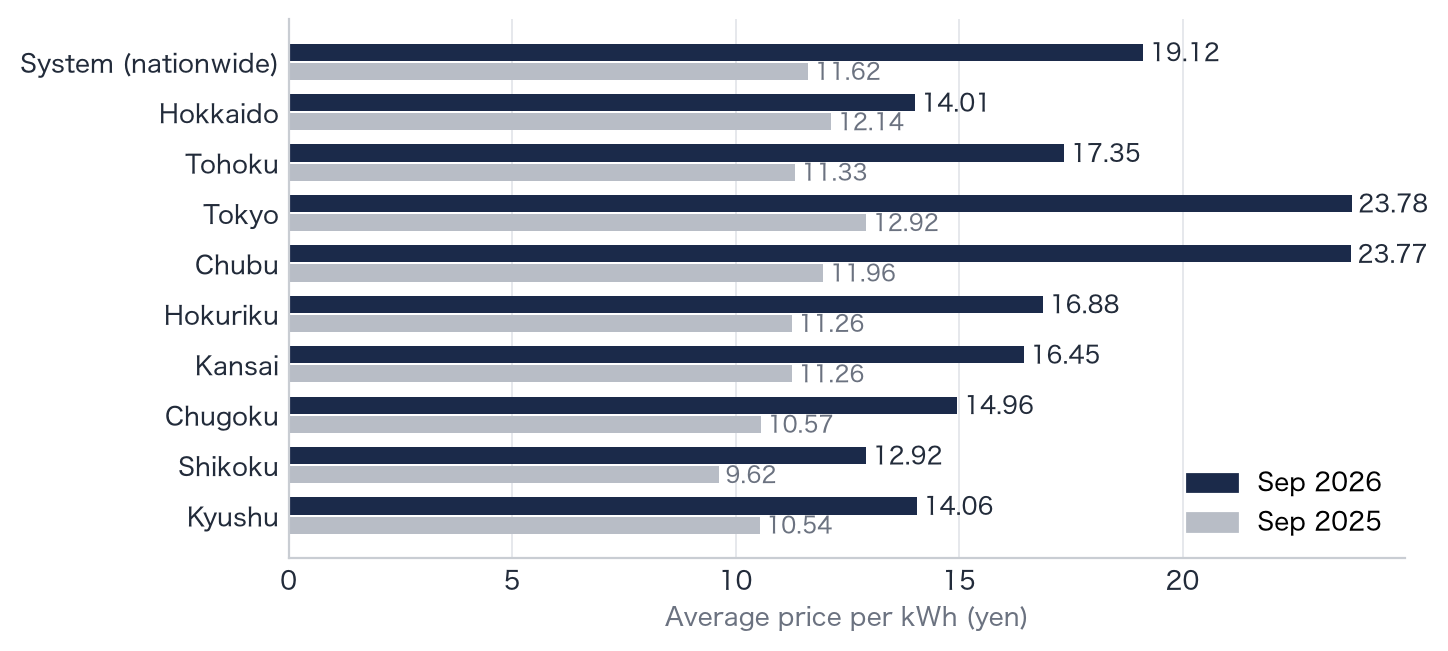
Wholesale electricity is electricity bought and sold by power companies and retailers. Its price is set on the "spot market" of the Japan Electric Power Exchange (JEPX), where electricity for the next day is traded the day before. "System (nationwide)" is the price when all of Japan is treated as one market (the system price). When the transmission lines between regions are congested, prices split by area, from Hokkaido to Kyushu (area prices).
The monthly average on wholesale electricity (JEPX) for System (nationwide) was 19.12 yen/kWh this month, against 11.62 yen/kWh in the same month last year. In Tokyo it was 23.78 yen/kWh this month, against 12.92 yen/kWh in the same month last year.

Source: Spot market trading results published by the Japan Electric Power Exchange (JEPX). Simple average of 30-minute prices. Compiled by ScienceX.
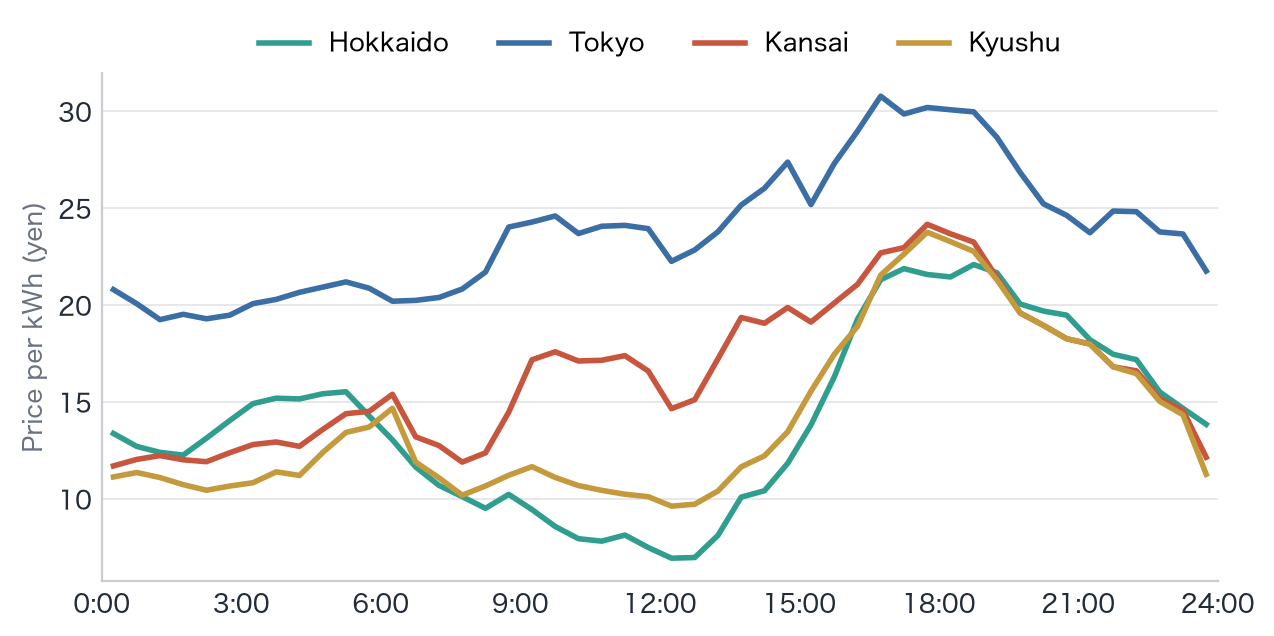
Wholesale electricity prices change every 30 minutes. The figure shows the shape of a day, averaging the prices at the same time of day across the month. If a battery stores electricity at cheap times and releases it at expensive times, the difference becomes its revenue.
The daily average low and high for wholesale electricity were 19.23 yen around 1:00 and 30.77 yen around 16:30 in Tokyo, and 9.61 yen around 12:00 and 23.75 yen around 17:30 in Kyushu.

Source: JEPX spot market. Compiled by ScienceX.
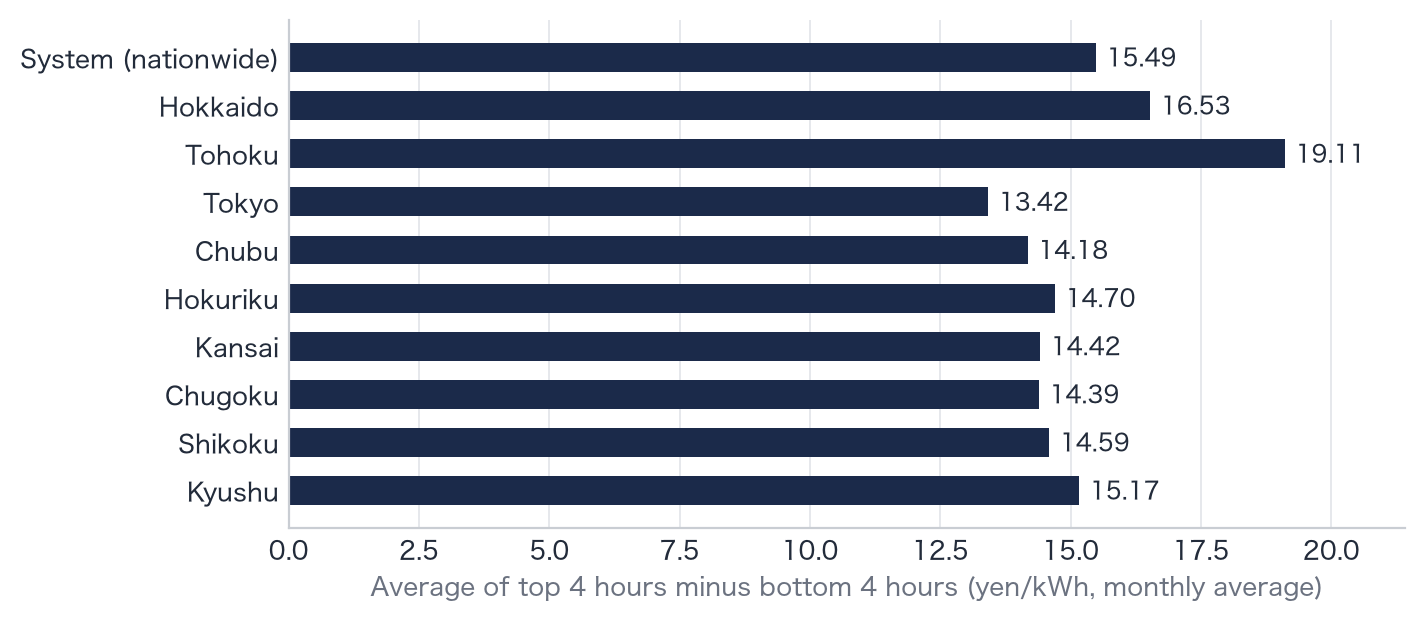
We took the average price of the day's 4 most expensive hours, subtracted the average price of the 4 cheapest hours, and listed the monthly average by area. This equals the difference per kWh from buying 1 kWh in the 4 cheapest hours and selling it in the 4 most expensive hours. It is a simple difference: electricity lost in charging and discharging and fees are not subtracted, and the order of the cheap and expensive hours is not considered.
The monthly average spread between the 4 most expensive and 4 cheapest hours on wholesale electricity was largest in Tohoku at 19.11 yen/kWh and smallest in Tokyo at 13.42 yen/kWh.

Source: JEPX spot market. Compiled by ScienceX.
| Area | 2-hour spread (yen/kWh) | 4-hour spread (yen/kWh) | Days with a 4-hour spread of 10 yen or more |
|---|---|---|---|
| System (nationwide) | 17.16 | 15.49 | 28 |
| Hokkaido | 18.36 | 16.53 | 25 |
| Tohoku | 21.00 | 19.11 | 27 |
| Tokyo | 15.23 | 13.42 | 24 |
| Chubu | 15.99 | 14.18 | 25 |
| Hokuriku | 16.35 | 14.70 | 19 |
| Kansai | 16.22 | 14.42 | 19 |
| Chugoku | 16.31 | 14.39 | 20 |
| Shikoku | 16.87 | 14.59 | 22 |
| Kyushu | 16.87 | 15.17 | 19 |
The spread is the monthly average of the daily spreads. September 2026 covers 30 days.
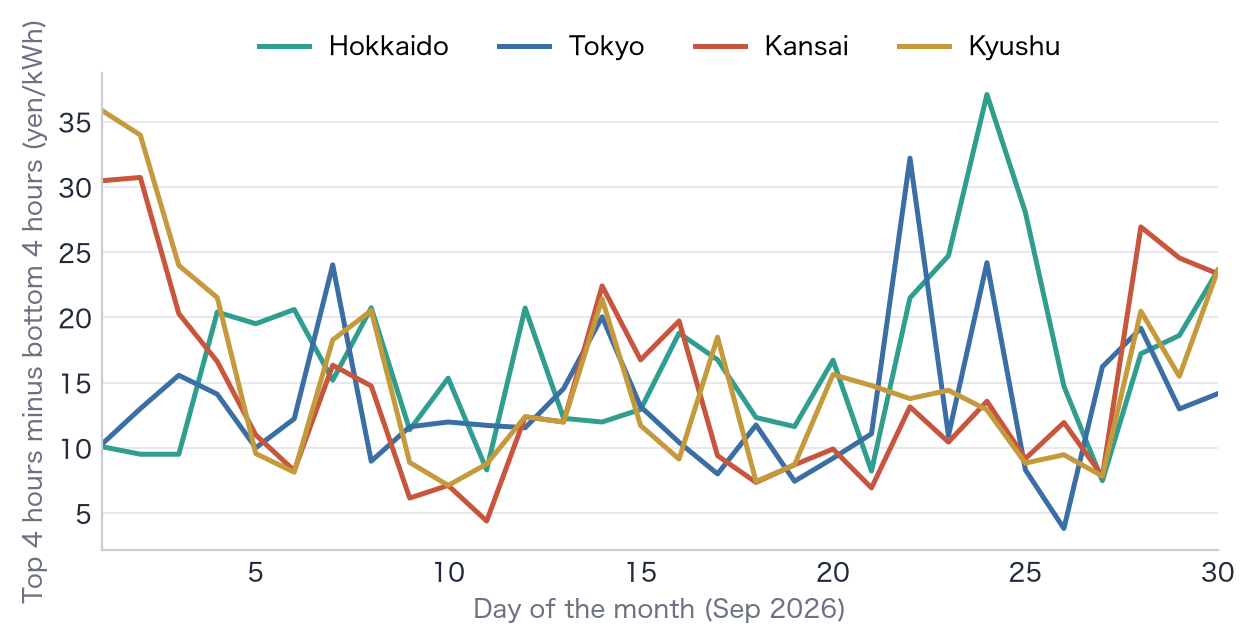
We listed the same 4-hour spread day by day. The larger the spread on a given day, the more room a battery has to earn from it.
Out of 30 days, the 4-hour spread on wholesale electricity was 10 yen or more on 28 days for System (nationwide), 27 days in Tohoku, and 19 days each in Hokuriku, Kansai and Kyushu.

Source: JEPX spot market. Compiled by ScienceX.
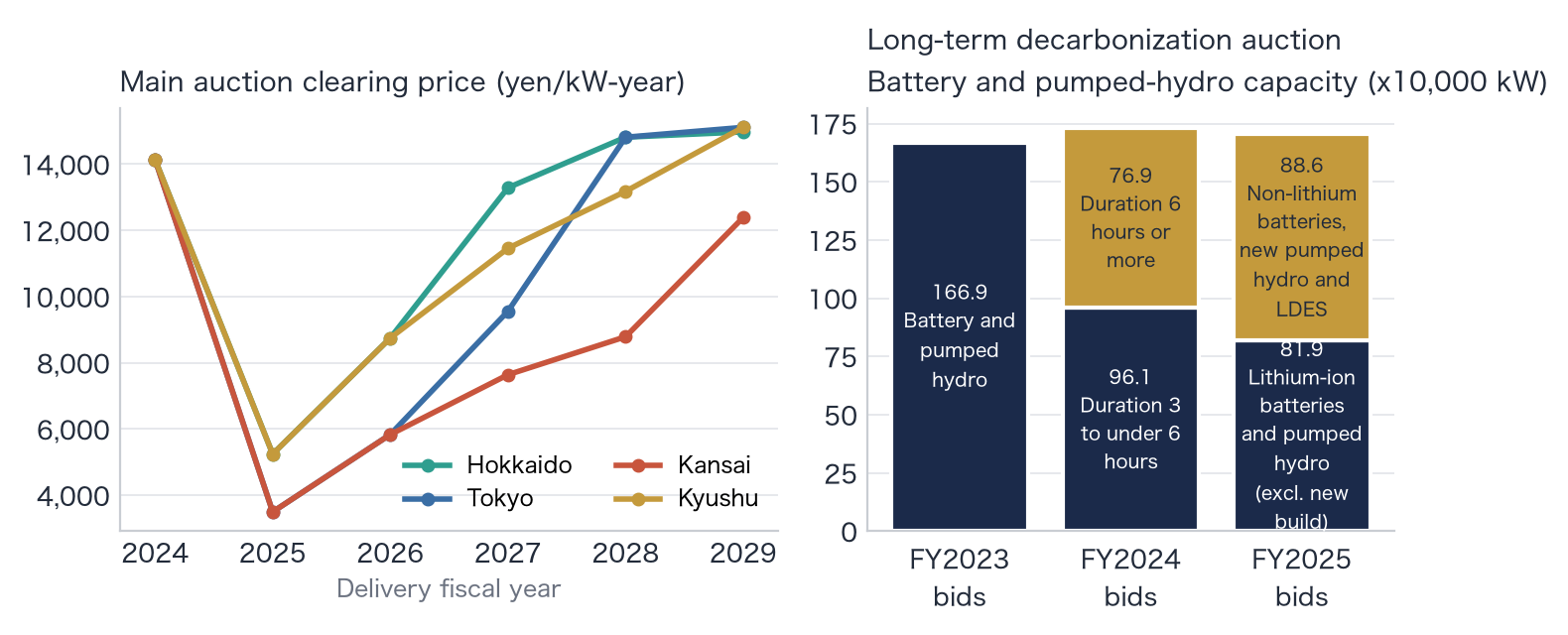
The capacity market buys electricity supply capacity 4 years ahead through an auction held once a year. Prices are set in yen per kW per year. The left figure shows the clearing prices of past main auctions. The right figure shows the battery and pumped hydro capacity awarded in the Long-Term Decarbonization Power Source Auction (a separate auction that, in principle, promises 20 years of capacity revenue for new decarbonized power sources and similar projects). These figures are published once a year, so they do not change each month. The latest is delivery FY2029 (published January 2026).
The capacity market clearing price for Tokyo was 14,137 yen/kW for delivery FY2024, 3,495 yen/kW for FY2025 and 15,111 yen/kW for FY2029. In the FY2025 Long-Term Decarbonization Power Source Auction, battery and pumped hydro awards were 819 MW for lithium-ion batteries and pumped hydro (excluding new builds), and 886 MW for non-lithium-ion batteries, pumped hydro (new builds) and LDES. Both are the latest published annual values and do not change each month.

Source: Clearing results and capacity assurance contract documents published by the Organization for Cross-regional Coordination of Transmission Operators (OCCTO) (sources listed in the last section (Assumptions and terms)). As published.
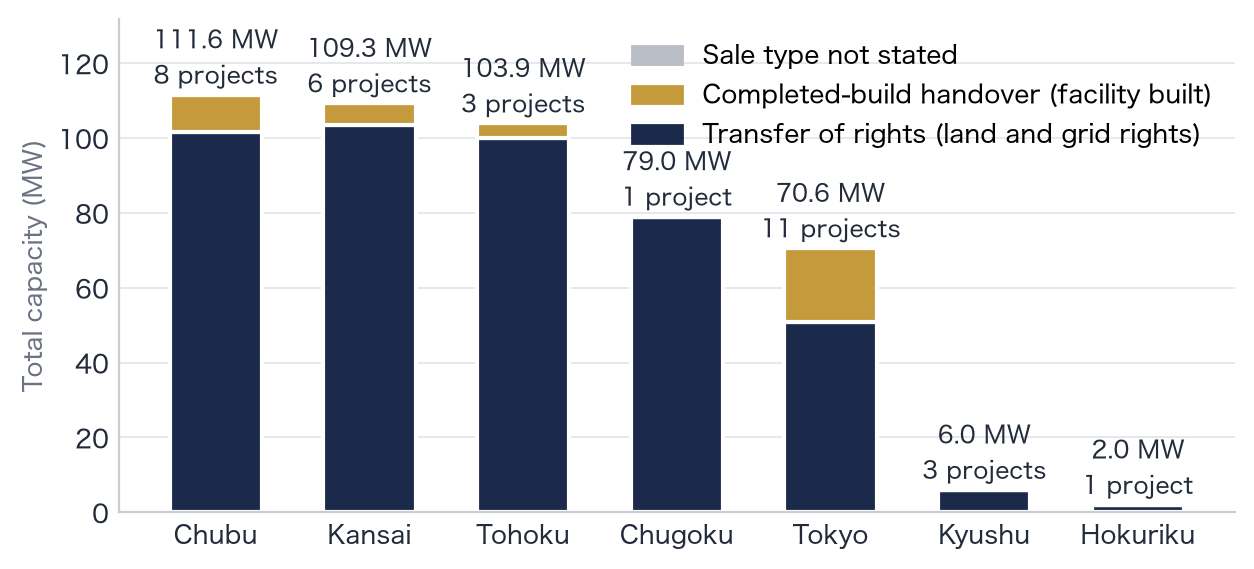
We counted the projects newly listed this month on our Chikudensho Market (our marketplace for battery storage sites, a site where we list battery storage projects), by grid area of the grid operator. These figures cover the projects we handled, not the whole market. Transfer of rights is a sale that hands over the land and power rights. Completed-build handover is a sale that hands over the facility once it is built.
New listings on Chikudensho Market in September 2026 were 33 projects, 482.4 MW. By grid area: Chubu 8 projects, 111.6 MW; Kansai 6 projects, 109.3 MW; Tohoku 3 projects, 103.9 MW.

Source: Chikudensho Market records (project locations are given only down to grid area; prices and parties are not listed).
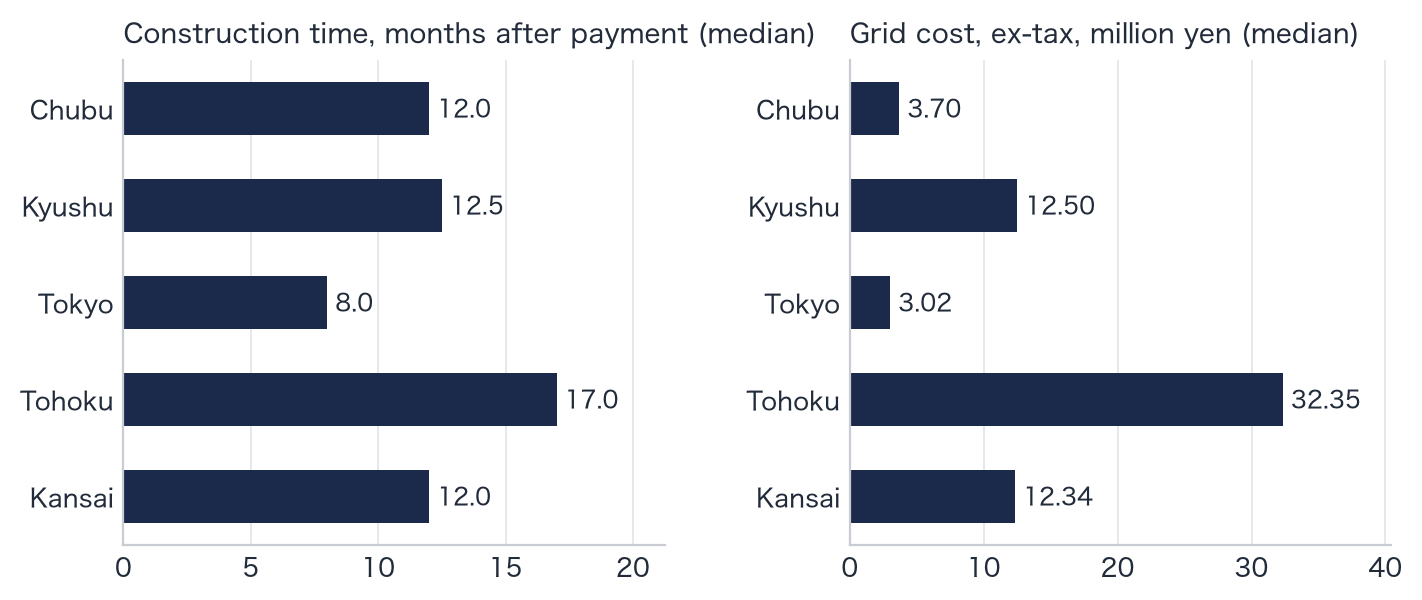
A grid connection study is the procedure of asking the grid operator to check "can we connect at this site, and how much will the work cost?" The grid connection cost contribution is the part of the connection work cost paid by the applicant. Of the response documents we received, we compiled only the high-voltage ones (connecting to a 6,600 V distribution line), by grid area. Extra-high voltage is not included. Grid areas with fewer than 5 cases are not shown.
Median values in grid connection study responses (high voltage only, as of October 19, 2026) ranged from 8.0 months in Tokyo to 17.0 months in Tohoku for construction time, and from ¥3.02 million in Tokyo to ¥32.35 million in Tohoku for the grid connection cost contribution.

Source: Compilation of the high-voltage grid connection study responses we received from grid operators (as of October 19, 2026).
We put the figures behind the charts into tables you can use in documents: ① nationwide figures by product for the balancing market (bid-to-requirement ratio, award rate, price, battery share), ② figures by area and trading volume for wholesale electricity (JEPX), and ③ capacity market clearing prices.
Balancing market (September 2026, preliminary, nationwide)
| Product | Requested volume (MW) | Bid volume (MW) | Awarded volume (MW) | Bid-to-requirement ratio (bids ÷ requested) | Award rate (awarded ÷ bids) | Average winning price (yen/kW per 30 min) | Battery share |
|---|---|---|---|---|---|---|---|
| Primary reserve (online) | 1,388.7 | 1,710.0 | 1,337.3 | 123.1% | 78.2% | 3.43 | 27.9% |
| Primary reserve (offline) | 497.8 | 418.4 | 265.7 | 84.0% | 63.5% | 5.79 | 100.0% |
| Secondary reserve 1 | 962.6 | 1,996.2 | 1,102.3 | 207.4% | 55.2% | 2.49 | 1.8% |
| Secondary reserve 2 | 983.1 | 3,709.3 | 2,163.2 | 377.3% | 58.3% | 2.51 | 1.0% |
| Tertiary reserve 1 | 2,498.5 | 5,895.9 | 3,021.0 | 236.0% | 51.2% | 2.28 | 0.7% |
| Tertiary reserve 2 | 376.3 | 1,371.7 | 368.9 | 364.5% | 26.9% | 2.22 | 0.8% |
| Composite product | 3,383.8 | 6,641.4 | 3,623.5 | 196.3% | 54.6% | 2.64 | 10.4% |
Volumes are averages per 30-minute slot. Products with a bid-to-requirement ratio below 100% received fewer bids than requested. The award rate is the share of the bid volume that was awarded.
Wholesale electricity, JEPX spot market (September 2026, by area, yen/kWh)
| Area | Monthly average | Same month last year | Daytime (8:00–16:00) | Evening (16:00–20:00) | 4-hour spread | Highest | 30-minute slots at 30 yen or more | 30-minute slots at 0.01 yen |
|---|---|---|---|---|---|---|---|---|
| System (nationwide) | 19.12 | 11.62 | 17.53 | 26.58 | 15.49 | 49.00 | 106 | 0 |
| Hokkaido | 14.01 | 12.14 | 9.59 | 21.15 | 16.53 | 50.01 | 30 | 56 |
| Tohoku | 17.35 | 11.33 | 11.48 | 26.21 | 19.11 | 50.01 | 90 | 16 |
| Tokyo | 23.78 | 12.92 | 24.38 | 29.40 | 13.42 | 50.01 | 265 | 0 |
| Chubu | 23.77 | 11.96 | 24.03 | 30.03 | 14.18 | 53.20 | 316 | 0 |
| Hokuriku | 16.88 | 11.26 | 18.30 | 22.55 | 14.70 | 53.20 | 164 | 0 |
| Kansai | 16.45 | 11.26 | 17.14 | 22.34 | 14.42 | 53.20 | 130 | 5 |
| Chugoku | 14.96 | 10.57 | 13.10 | 21.71 | 14.39 | 53.20 | 87 | 22 |
| Shikoku | 12.92 | 9.62 | 11.15 | 18.32 | 14.59 | 53.20 | 78 | 61 |
| Kyushu | 14.06 | 10.54 | 11.63 | 21.71 | 15.17 | 53.20 | 79 | 45 |
Trading volume (September 2026, total for 30 days): total contracted volume 32,413 million kWh (same month last year 24,757 million kWh), sell bids 51,279 million kWh, buy bids 40,562 million kWh.
Capacity market main auction area prices (yen/kW per year)
| Delivery fiscal year | Hokkaido | Tohoku | Tokyo | Chubu | Hokuriku | Kansai | Chugoku | Shikoku | Kyushu |
|---|---|---|---|---|---|---|---|---|---|
| FY2024 | 14,137 | 14,137 | 14,137 | 14,137 | 14,137 | 14,137 | 14,137 | 14,137 | 14,137 |
| FY2025 | 5,242 | 3,495 | 3,495 | 3,495 | 3,495 | 3,495 | 3,495 | 3,495 | 5,242 |
| FY2026 | 8,749 | 5,833 | 5,834 | 5,832 | 5,832 | 5,832 | 5,832 | 5,832 | 8,748 |
| FY2027 | 13,287 | 9,044 | 9,555 | 7,823 | 7,638 | 7,638 | 7,638 | 7,638 | 11,457 |
| FY2028 | 14,812 | 14,812 | 14,812 | 10,280 | 8,785 | 8,785 | 8,785 | 8,785 | 13,177 |
| FY2029 | 14,972 | 15,111 | 15,111 | 12,388 | 12,388 | 12,388 | 12,388 | 12,388 | 15,112 |
Battery and pumped hydro capacity awarded in the Long-Term Decarbonization Power Source Auction (10,000 kW)
| Auction year | Category | Awarded capacity (10,000 kW) |
|---|---|---|
| FY2023 auction | Batteries and pumped hydro | 166.9 |
| FY2024 auction | Operating duration of 3 hours or more and less than 6 hours | 96.1 |
| FY2024 auction | Operating duration of 6 hours or more | 76.9 |
| FY2025 auction | Lithium-ion batteries and pumped hydro (excluding new builds) | 81.9 |
| FY2025 auction | Non-lithium-ion batteries, pumped hydro (new builds) and LDES | 88.6 |
Monthly JEPX averages and 4-hour spreads by area, and capacity market area prices, laid out across issues. CSV downloads included.
You are welcome to quote the figures and charts on this page. Please give the source as follows.
Source: Science X Inc., “Battery Storage Market Notes, September 2026 issue” (updated 2026-11-22), https://www.scix.co.jp/en/research/2026-09
The figures are tallies of published data and our own records. The price spread is a difference in price per kWh and does not show actual revenue. How we compiled them is in the last section, “Assumptions and terms”. Figures across issues are on market data (CSV), and the reuse terms are in the citation guide.
Each month's update also arrives in our LinkedIn newsletter, “Japan grid-scale BESS: primary data”. Subscribe to the newsletter →
On Chikudensho Market, our marketplace for battery storage sites, you can browse current listings without registering. Prices and documents are available after free registration, where you agree to a confidentiality undertaking on the registration screen (no signed paper is needed).
Register free to see prices and documents → Browse projects on Chikudensho Market